Aghor Sadhna Kya Hai: A Complete Guide to the Path of Fearless Self-Realization
Aghor Sadhna Kya Hai is a question that intrigues many spiritual seekers who come across images of ash-smeared sadhus or hear about practice
Aghor Sadhna Kya Hai
Aghor Sadhna Kya Hai | अघोर साधना क्या है
Aghor Sadhna Kya Hai is a question that intrigues many spiritual seekers who come across images of ash-smeared sadhus or hear about practices linked to cremation grounds. In simple terms, Aghor Sadhana is an intense spiritual discipline rooted in Shaivism. It aims to free the seeker from fear, dualities, and the limited sense of self so that one experiences the divine presence in everything.
This path is often misunderstood. Many people associate it only with extreme or shocking rituals. In reality, true Aghor Sadhana focuses on dissolving the ego, transcending ideas of pure and impure, and realizing non-duality. The goal is not powers or miracles but liberation (moksha) and a fearless state of consciousness while still living.
In this detailed guide, we explore the meaning, philosophy, practices, principles, and practical aspects of Aghor Sadhana in clear and accessible language.
Understanding the Meaning of Aghor
The word “Aghor” comes from Sanskrit. “Ghora” means terrible, fearful, or dreadful. Adding the prefix “A” turns it into “not dreadful” or “beyond fear and darkness.” Aghor therefore points to a natural state of consciousness free from fear, hatred, disgust, and discrimination.
An Aghori does not see separation between life and death, good and evil, or pure and impure. Everything is viewed as an expression of the Divine, often identified with Lord Shiva in his Bhairava or Aghora form. This state is sometimes called Aghor-bhav — a mindset where dualities lose their power over the mind.
Aghor Sadhana is the disciplined effort to reach and stabilize this state. It is not about adopting a frightening appearance for its own sake. The external practices serve as tools to confront and transcend the mind’s deep-seated fears and aversions.
History and Origins of Aghor Sadhana
Aghor traditions have deep roots in older Tantric and Kapalika streams of Shaivism that developed in medieval India. The philosophy draws from the idea that Shiva’s Aghora face represents the aspect beyond terror. Lineages often connect the knowledge to figures such as Dattatreya and later teachers who systematized the path.
A significant modern lineage is associated with Baba Kinaram of Varanasi (16th–17th century). His teachings and the subsequent Aghor tradition emphasize both rigorous sadhana and, in some branches, social service toward those rejected by mainstream society. Over centuries, different gurus have refined or reformed aspects of the practice while keeping the core non-dual vision intact.
Today, Aghor Sadhana continues through living guru-disciple lineages. Authentic transmission remains central; the path is not meant to be followed from books alone.
The Core Philosophy of Aghor Sadhana
At its heart, Aghor Sadhana rests on Advaita (non-duality). The seeker trains to see Shiva (or the Absolute) in every experience — the beautiful and the repulsive, the living and the dead, the socially accepted and the taboo.
Human beings are bound by the Ashta Pasha (eight fetters): lust, anger, greed, attachment, fear, hatred, shame, and disgust. Aghor practices deliberately confront these bonds so they lose their grip. By repeatedly facing what the ordinary mind rejects, the practitioner weakens the ego’s control and opens to a wider, freer awareness.
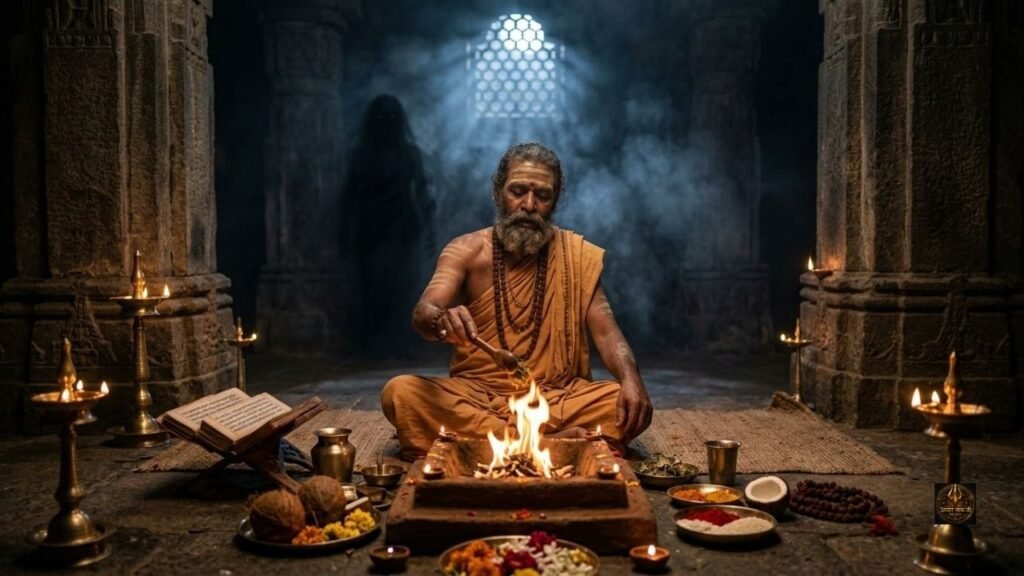
This is why cremation grounds (shmashan) hold special importance. They are places where life and death meet openly. Meditating there reminds the seeker of impermanence and helps burn mental attachments the way fire burns a body. The ashes (bhasma) smeared on the body serve as a constant reminder of mortality and equality — every body eventually returns to ash. Aghor Sadhna Kya Hai
The philosophy does not glorify impurity for its own sake. It uses confrontation with social and psychological taboos as a method to realize that nothing stands outside the Divine. Aghor Sadhna Kya Hai
Main Types of Aghor Sadhana
Traditional descriptions often speak of progressive stages of practice. While details vary by lineage and are given only under a qualified guru, three commonly mentioned forms are:
Shmashan Sadhana (Cremation-Ground Practice)
This is the most widely known. The seeker spends extended time in cremation grounds, meditating, observing funeral rites, and internalizing the reality of death. The environment itself becomes the teacher. Fear of darkness, isolation, and mortality is faced directly until it dissolves. Aghor Sadhna Kya Hai
Shiva Sadhana
This focuses on deep worship and identification with Shiva, often through mantra, meditation, and visualization of Shiva’s fierce yet compassionate forms such as Bhairava. It strengthens the inner connection to the source of the tradition.
Shava Sadhana
In certain advanced contexts, a corpse may be used as a seat or altar for ritual. The practice is highly restricted, symbolically powerful, and intended only for those who have already developed significant detachment and under strict guidance. It is not a casual or public activity. Aghor Sadhna Kya Hai
Other supporting elements can include the use of a kapala (skull bowl) as a reminder of impermanence, controlled use of certain substances in specific ritual contexts, and long periods of solitude, silence, and austerity. Duration of serious practice is often described in years rather than weeks or months; some traditions speak of a multi-year process under a guru. Aghor Sadhna Kya Hai
Key Principles That Guide Aghor Sadhana
Authentic Aghor practice is governed by inner discipline rather than external show. Core principles include:
- Seeing divinity in everything (Sarvam Shivamayam).
- Transcending dualities of pure/impure and good/bad through direct experience rather than intellectual argument.
- Complete surrender to the guru and the lineage.
- Cultivating fearlessness and equanimity.
- Using the body and mind as laboratories for transformation rather than sources of indulgence.
- Balancing intense sadhana with, in many modern lineages, selfless service (seva).
These principles are transmitted personally. Public descriptions can never replace living guidance.
Benefits and Inner Transformation
When practiced correctly under guidance, Aghor Sadhana can lead to:
- Profound reduction of fear, especially fear of death.
- Greater emotional equanimity and reduced reactivity.
- Dissolution of rigid ego patterns and social conditioning.
- Deeper experience of non-dual awareness.
- A sense of freedom and naturalness in daily life.
- For some practitioners, heightened intuition or healing capacities that arise as side effects of the work rather than as primary goals. Aghor Sadhna Kya Hai
The ultimate benefit is described as jivanmukti — liberation while still embodied.
How to Approach Aghor Sadhana Safely and Authentically
Aghor Sadhana is not suitable for casual experimentation. It demands mental stability, sincerity, and a genuine longing for truth rather than powers or thrills. The essential first step is finding a living, authentic guru who belongs to a recognized lineage and can assess the seeker’s readiness. Aghor Sadhna Kya Hai
Self-taught attempts at extreme practices can be psychologically and spiritually harmful. Many genuine teachers emphasize that the outer forms (ashes, cremation grounds, etc.) are secondary to the inner work of non-discrimination and ego dissolution. Modern expressions of the path sometimes place greater weight on service, mantra, and meditation while still honoring the traditional intensity. Aghor Sadhna Kya Hai
If you feel drawn to this path, begin with study of reliable sources, self-inquiry into your own fears and dualities, and sincere prayer for right guidance. Contact established teachers rather than relying solely on internet information.
Common Misconceptions About Aghor Sadhana
Many popular images focus only on the most dramatic elements and miss the philosophical depth. Aghor is not primarily about black magic, harming others, or seeking supernatural powers. While some individuals may misuse the name, authentic practice aims at liberation and compassion that arises from seeing the self in all. Not every ash-smeared figure is a realized Aghori, and not every Aghori lives permanently in a cremation ground. Aghor Sadhna Kya Hai
The path is demanding and selective. It is one among many valid spiritual roads within the broader Hindu and Tantric landscape. Aghor Sadhna Kya Hai
Conclusion: Walking the Fearless Path
Aghor Sadhna Kya Hai? It is the disciplined journey beyond fear into the recognition that nothing is outside the Divine. Through confrontation with death, taboos, and the mind’s deepest aversions, the seeker learns to rest in a state of natural freedom and non-dual awareness. Aghor Sadhna Kya Hai
The path requires courage, patience, and, above all, the guidance of a realized teacher. When approached with sincerity and humility, it offers a radical route to self-realization that has been walked by dedicated practitioners for centuries.
For those seeking authentic guidance on Aghor traditions and related spiritual practices, you may connect with:
Aghor Nath Ji Maharaj
📞 Call / WhatsApp: +91-7340452967
📧 Email: contacts@aghornathjimaharaj.info
🌐 Website: https://www.aghornathjimaharaj.info/
May every sincere seeker find the light that is already present beyond all darkness.








1 thought on “Aghor Sadhna Kya Hai: A Complete Guide to the Path of Fearless Self-Realization”