Mrityu Ke Baad Kya Hota Hai
Mrityu Ke Baad Kya Hota Hai Death is one of the greatest mysteries of human life. Every person, at some point, wonders: “Mrityu ke baad kya hota
Mrityu Ke Baad Kya Hota Hai
What Happens After Death According to Hindu Tradition
Mrityu Ke Baad Kya Hota Hai Death is one of the greatest mysteries of human life. Every person, at some point, wonders: “Mrityu ke baad kya hota hai?” What happens after we leave this body? In Hindu tradition, death is not the end. It is a transition. The soul (Atman) is eternal, while the physical body is temporary. Ancient texts like the Garuda Purana, Upanishads, and the teachings of Aghori and Tantrik traditions offer detailed guidance on this journey.
This article explains in simple, clear English what traditional knowledge says about the soul’s path after death, the importance of last rites, different possible destinations based on karma, and how Aghoris view death as a powerful teacher. The aim is to bring clarity and reduce fear through understanding.
The Eternal Nature of the Soul
According to Hindu philosophy, the soul never dies. The Bhagavad Gita clearly states that the Atman is unborn, eternal, and indestructible. Just as a person changes old clothes for new ones, the soul leaves one body and moves toward another experience. Mrityu Ke Baad Kya Hota Hai
Death is only the separation of the physical body from the subtle body (linga sharira). The subtle body carries the impressions of all thoughts, actions, and desires (samskaras and karma). These impressions decide the next stage of the soul’s journey.
What Happens at the Moment of Death
Traditional texts describe that at the time of death, the life force (prana) withdraws from the body. Depending on the person’s karma:
- Virtuous souls are guided peacefully by divine messengers.
- Those with heavier negative karma may experience more struggle as Yamadutas (messengers of Yama) arrive.
The soul is said to take a subtle form, often described as the size of a thumb. In the first few moments, it remains near the body and the family, still attached to the world it has just left.
The First 13 Days: The Preta Stage
One of the most important teachings of the Garuda Purana is about the first 13 days after death. During this period, the soul is in the “preta” state – a transitional, restless condition.
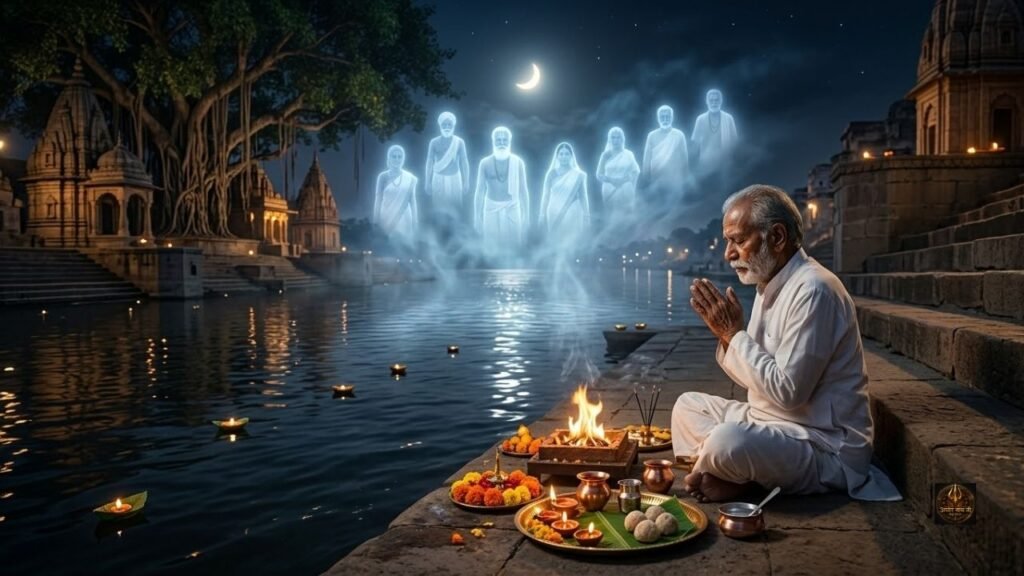
Family members perform daily rituals, especially pinda daan (offering of rice balls). These offerings are believed to help the soul form a temporary subtle body that gives it strength for the onward journey. Without proper rites, the soul may remain confused, hungry, and attached to the earthly plane for a longer time.
On the 13th day (terahvin), the soul is traditionally said to leave the home permanently and begin its longer journey toward Yamaloka, the realm of Lord Yama, the lord of justice. Mrityu Ke Baad Kya Hota Hai
The Journey to Yamaloka and Judgment
After the 13th day, the soul travels a long subtle path. Texts describe this journey as lasting weeks or even months in earthly terms. Along the way, the soul faces experiences that reflect its own past actions. Mrityu Ke Baad Kya Hota Hai
When the soul reaches the court of Yama, Chitragupta (the divine record-keeper) presents a complete account of every thought, word, and deed. Based on this, the soul experiences the results of its karma:
- Temporary stay in higher realms (Swarga) for those with strong positive karma
- Temporary suffering in lower states (Naraka) for those with heavy negative karma
- Eventual rebirth according to remaining karma
Heaven and hell in Hindu tradition are not permanent. They are temporary states where the soul experiences the fruits of its actions before continuing the cycle of birth and death (samsara). Mrityu Ke Baad Kya Hota Hai
Special Cases: Untimely Death and Restless Spirits
When death occurs before the natural lifespan (akal mrityu) through accident, violence, or other unnatural causes, the soul may remain restless for a longer period. Such spirits are often called pret or bhoot. They may stay near the earthly plane until the remaining natural lifespan is completed or until special rituals (such as Narayan Bali in some traditions) help release them.
This is why proper last rites, shraddha, and tarpan are considered so important. They support the soul’s peaceful transition and protect the living family from lingering attachment.
How Aghoris View Death
Aghoris have a unique and fearless approach to death. Living close to cremation grounds (smashan), they constantly face the reality of mortality. For an Aghori, death is not something to fear – it is the greatest teacher.
Aghori philosophy teaches non-duality. Life and death are two sides of the same reality. By meditating in the smashan, smearing sacred ash, and confronting what society considers impure, Aghoris aim to transcend the fear of death and the illusion of separation. Their goal is liberation (moksha) – freedom from the endless cycle of birth and death.
In this view, understanding death deeply while alive is the key to living with courage, detachment, and true freedom.
What the Living Can Do
Understanding “Mrityu ke baad kya hota hai” is not only about the departed. It also guides how we live and how we support those who leave us: Mrityu Ke Baad Kya Hota Hai
- Live with awareness of karma. Every action leaves an impression.
- Perform last rites and annual shraddha with sincerity and devotion.
- Maintain purity of mind and reduce unnecessary attachments.
- Practice simple protective and purifying mantras regularly.
- If a family faces prolonged disturbances after a death, seek guidance from an experienced spiritual practitioner rather than relying on fear-based remedies.
Finding Peace Through Right Guidance
Death is natural. Fear of death is not. When families understand the traditional process and perform the necessary rites with faith, both the departed soul and the living find greater peace.
Aghor Nath Ji Maharaj is known among seekers for his deep understanding of smashan traditions, spiritual protection, and guiding families through the sensitive matters related to death, restless spirits, and energetic disturbances. His approach combines traditional knowledge with practical support so that people can move forward with clarity rather than fear.
Conclusion: Death Is a Transition, Not the End
“Mrityu ke baad kya hota hai” is answered clearly in Hindu tradition: the soul continues its journey according to karma. The physical body returns to the elements, but the Atman moves forward. Proper rites, righteous living, and spiritual understanding help make this transition peaceful. Mrityu Ke Baad Kya Hota Hai
By learning about the soul’s path, we learn how to live better – with less attachment, more awareness, and greater compassion. Death reminds us that this life is precious and temporary. How we use it decides the quality of our next experience. Mrityu Ke Baad Kya Hota Hai
If you or your family need guidance related to last rites, ancestral peace, spiritual protection, or understanding disturbances after a death, sincere help is available. Mrityu Ke Baad Kya Hota Hai
Aghor Nath Ji Maharaj
Website: https://www.aghornathjimaharaj.info/
Call / WhatsApp: +91-7340452967
Email: info@aghornathjimaharaj.info
May every soul find peace on its journey, and may every living being live with courage, clarity, and devotion.