Aghor Marg Kya Hota Hai
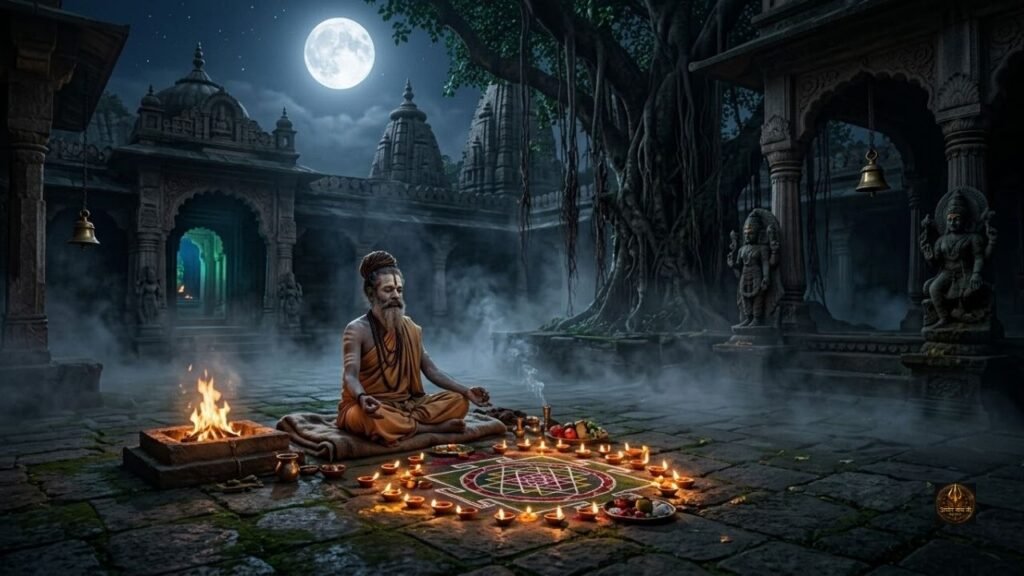
Aghor Marg Kya Hota Hai
Aghor Marg Kya Hota Hai Many people hear the words “Aghor” or “Aghori” and immediately think of cremation grounds, ashes, skulls, and intense rituals. While these outer images are part of the tradition, they do not fully explain the deeper meaning. The real question is: Aghor Marg Kya Hota Hai? What exactly is the Aghor path, and why does it exist?
This article answers that question in simple, clear English. You will learn the true meaning of Aghor Marg, its philosophy, history, main practices, differences from other spiritual paths, and why it continues to attract serious seekers. The goal is to replace confusion and fear with accurate understanding.
Meaning of Aghor Marg Understanding the Path of Fearlessness
Aghor Marg literally means the “Path of Aghora.” The Sanskrit word Aghora is formed from “A” (not) and “Ghora” (dreadful or terrible). Therefore, Aghora means “that which is not dreadful” or “beyond fear.” Aghor Marg Kya Hota Hai
Aghor Marg is a Tantric spiritual path within the broader Shaiva tradition. Its central aim is to help the seeker reach a state of complete non-duality — a state where the mind no longer divides life into pure and impure, good and bad, sacred and ordinary. In this state, fear dissolves and the seeker realises oneness with the Absolute, which Aghoris identify as Shiva in the form of Bhairava. Aghor Marg Kya Hota Hai
Unlike paths that emphasise only purity, rituals, or intellectual study, Aghor Marg deliberately works with the aspects of existence that ordinary society rejects or fears. By facing these directly, the sadhak cuts the deepest roots of ego and dualistic thinking.
Historical Roots of Aghor Marg
The Aghor tradition traces its spiritual lineage to Lord Shiva himself, specifically to the Aghora face of Sadashiva. According to traditional accounts, this knowledge was transmitted through Guru Dattatreya and later through the Nath and Kapalika streams.
In more recent centuries, the living form of the path is strongly connected with Baba Keenaram of Varanasi, who is regarded as a key figure in organising and spreading the Aghor parampara. His ashram remains an important centre. Over time, different branches developed, but the essential focus on fearlessness, non-discrimination, and intense sadhana remained the same.
Aghor Marg is therefore not a modern invention. It is a continuation of an ancient Tantric approach that has always existed on the edges of mainstream religious practice.
Core Philosophy of the Path
The foundation of Aghor Marg rests on a few clear principles:
- Everything that exists is a manifestation of Shiva. Nothing is outside the divine.
- The human soul is bound by eight great nooses (Ashta Pasha): lust, anger, greed, attachment, pride, jealousy, fear, and disgust.
- Dualistic thinking itself is the main obstacle to liberation.
- True freedom comes only when the mind stops rejecting any part of existence.
Because of this view, Aghor sadhana does not avoid death, impurity, or social taboos. Instead, it uses them as tools for rapid transformation. The goal is not to become “impure” but to go beyond the very idea of purity and impurity.
Key Practices and Disciplines in Aghor Marg
Aghor Marg includes both outer and inner disciplines. The outer practices support the inner shift in consciousness.
Shamshan Sadhana
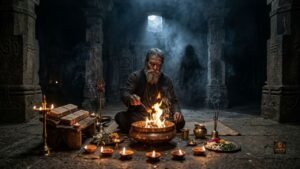
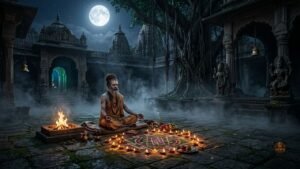
Meditation and ritual work performed in cremation grounds. The constant presence of death helps the sadhak confront mortality and dissolve body-identification. bAghor Marg Kya Hota Hai
Use of Vibhuti and Kapala
Sacred ash from the cremation ground and the human skull bowl serve as continuous reminders of impermanence and non-attachment.
Mantra and Tantric Rituals
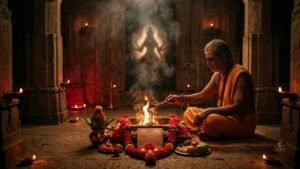
Specific mantras connected with Bhairava and the fierce forms of the Divine Mother are practised under strict guidance. These are not for public display or casual use. Aghor Marg Kya Hota Hai
Inner Work on Duality
The most important practice is continuous awareness. The sadhak trains the mind to remain equal in pleasure and pain, praise and blame, life and death.
These practices are never meant to be performed without a qualified Guru. Improper practice can create imbalance rather than freedom. Aghor Marg Kya Hota Hai
How Aghor Marg Differs from Other Spiritual Paths
Many spiritual traditions focus on purity, devotion, knowledge, or ethical living. Aghor Marg does not reject these but goes further by directly confronting the shadow side of human experience.
- Compared to mainstream Bhakti or Vedanta paths, Aghor places greater emphasis on experiential confrontation with fear.
- Compared to Naga sadhus, Aghoris focus more on Tantric energy work and less on public renunciation displays.
- Compared to commercial “tantra” services, authentic Aghor Marg aims at permanent inner transformation, not temporary problem-solving.
The path is considered difficult and is traditionally reserved for those with strong determination and the guidance of a living master.
Who Can Walk the Aghor Marg?
Aghor Marg is not suitable for everyone. It requires:
- Strong physical and mental stability
- Willingness to face one’s deepest fears
- Complete surrender to a genuine Guru
- Purity of intention (not desire for powers or control over others)
People who approach it out of curiosity, revenge, or the wish for quick supernatural results usually harm themselves. The tradition itself acts as a filter — only those who are ready can stay on the path for long. Aghor Marg Kya Hota Hai
The Central Role of the Guru
In Aghor Marg, the Guru is not optional. The path works with intense subtle energies. Only a realised master can protect the disciple, correct mistakes, and transmit the living current of fearlessness. Self-initiation through books, videos, or imagination is strongly discouraged. Aghor Marg Kya Hota Hai
A genuine Guru tests the disciple’s sincerity over time and never creates dependency or fear for personal gain.
Common Misunderstandings About Aghor Marg
Myth: Aghor Marg is only about black magic or harming others.
Reality: Authentic Aghor aims at liberation and the welfare of all beings. Misuse of knowledge exists in every tradition, but it is not the true path.
Myth: Anyone living in a cremation ground is an Aghori.
Reality: Outer location alone means nothing without inner realisation and proper initiation.
Myth: Aghor practice is against dharma.
Reality: From the non-dual viewpoint of Aghora, the path is a direct method of realising the highest dharma — oneness with Shiva.
Seeking Authentic Understanding Today
For those who feel a sincere attraction toward the deeper meaning of Aghor Marg and wish to understand spiritual protection or traditional knowledge connected with this path, responsible guidance is important.
Aghor Nath Ji Maharaj
Website: https://www.aghornathjimaharaj.info/
Call / WhatsApp: +91-7340452967
Email: contacts@aghornathjimaharaj.info
He is known among seekers for sharing traditional Mashani knowledge and offering practical spiritual guidance rooted in the living Aghor understanding.
Conclusion: The Real Meaning of Aghor Marg
Aghor Marg Kya Hota Hai? At its heart, it is the path that takes the seeker beyond fear. It is not a collection of strange rituals or a way to gain control over others. It is a radical method of dissolving the dualistic mind so that only the pure awareness of Shiva remains. Aghor Marg Kya Hota Hai
The outer forms — ashes, cremation grounds, fierce mantras — are only supports. The real journey happens inside. When fear ends, the state of Aghora naturally arises. Aghor Marg Kya Hota Hai
This path is demanding and not meant for casual exploration. Yet its message is powerful for every seeker: the things we fear most often hide the door to freedom. Approached with sincerity, humility, and the guidance of a true master, Aghor Marg can become a direct road to liberation.
May the grace of Lord Bhairava and the protective energy of the Divine Mother bring clarity, courage, and lasting peace to every genuine seeker on the path. Aghor Marg Kya Hota Hai