Karnapishachini aur Tantra: Exploring the Connection, Nature, and Traditional Understanding
Karnapishachini aur Tantra The phrase “Karnapishachini aur Tantra” brings together two subjects that often appear in discussions of Indian esote
Karnapishachini aur Tantra
Karnapishachini aur Tantra The phrase “Karnapishachini aur Tantra” brings together two subjects that often appear in discussions of Indian esoteric traditions. Many seekers want to understand how this particular energy relates to the broader system of Tantra, what place it occupies, and what traditional voices actually say about it. This article offers a clear, balanced, and informative exploration written in simple English. It aims to give useful context without exaggeration or unnecessary mystery.
Understanding Tantra in Simple Terms
Tantra is a vast and ancient body of spiritual knowledge and practice that developed within the Indian subcontinent. At its core, Tantra seeks to work with energy, consciousness, and the forces of nature in a systematic way. It includes a wide range of approaches—some focused on pure devotion and meditation, others involving more intense or specialised methods.
Tantra is not a single uniform path. It contains different currents. Some are sattvic, emphasising purity, clarity, and gradual inner transformation. Others are more rajasic or tamasic, working with stronger, denser, or more challenging energies. The tradition itself recognises that different practices suit different temperaments and levels of readiness. Because of this diversity, the relationship between Karnapishachini aur Tantra cannot be reduced to one simple statement. Karnapishachini aur Tantra
The Place of Karnapishachini within Tantric Traditions
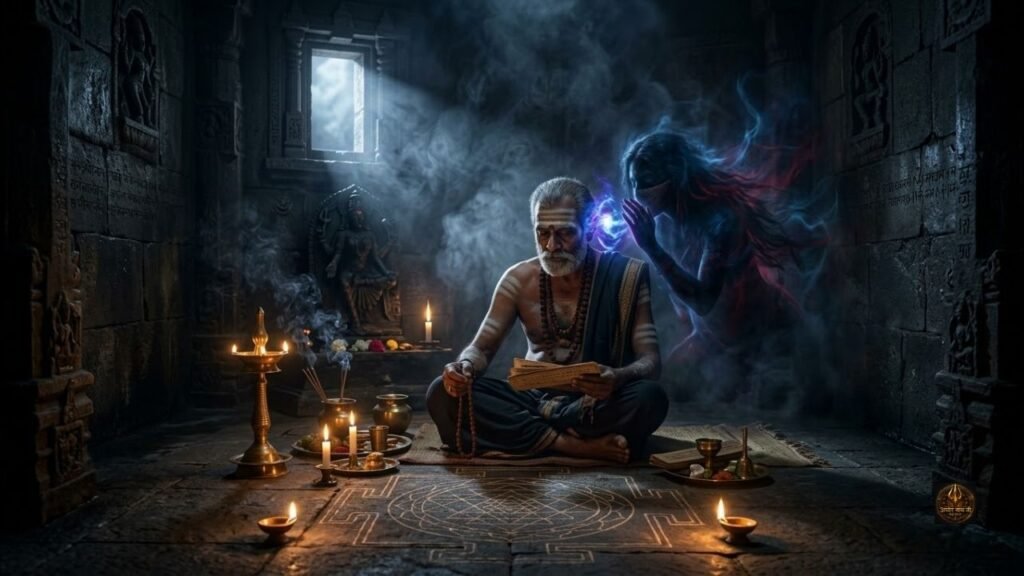
Karnapishachini appears in certain specialised branches of tantric and Aghor practice. Traditional descriptions present her as a feminine spirit or subtle energy associated with the ear and with the transmission of hidden information. She is generally classified among the lower or tamasic forms rather than among the higher deities of the tantric pantheon.
In the wider map of Tantra, she occupies a peripheral and demanding position. Most classical tantric systems give primary importance to deities such as Shiva, Shakti in her many forms, Bhairava, Kali, Tara, and other major figures. Practices involving entities like Karnapishachini are treated as specialised, restricted, and often cautionary. They are not presented as central or necessary for spiritual progress. Karnapishachini aur Tantra
When people discuss Karnapishachini aur Tantra, they are usually referring to this specialised corner of the tradition rather than to mainstream tantric worship or meditation. Understanding this distinction helps avoid confusion. Not every aspect of Tantra involves such energies, and many serious practitioners deliberately stay away from them.
Why This Connection Attracts Attention
The link between Karnapishachini aur Tantra draws interest for several reasons. Tantra itself has long been associated in popular imagination with secret knowledge, power, and unconventional methods. Karnapishachini, with her reported ability to convey information through subtle sound, fits into that image of hidden capability.
Some seekers are drawn by the idea of gaining insight that ordinary perception cannot provide. Others are simply curious about the more intense or lesser-known sides of the tradition. In both cases, the attraction often rests on incomplete information. Traditional teachers repeatedly emphasise that the more intense the practice, the greater the need for preparation, purity of intention, and living guidance.
The Tamasic Nature and Its Implications
One of the most consistent points made by experienced voices is that practices linked with Karnapishachini belong to the tamasic category. Tamas refers to qualities of darkness, density, inertia, and intensity. In tantric classification, tamasic methods are considered powerful but also risky. They require a high degree of inner strength, discipline, and the ability to remain balanced under pressure.
Because of this nature, the connection between Karnapishachini aur Tantra is often described as a double-edged one. The same intensity that is said to produce certain results can also create disturbance if the practitioner is unprepared. Traditional warnings focus less on dramatic stories and more on practical consequences: mental restlessness, difficulty maintaining ordinary spiritual practices, strain in relationships, and the challenge of managing an ongoing subtle presence.
This is why many teachers advise that such practices should never be approached through books, videos, or independent experimentation. Within authentic lineages, advanced or specialised methods are transmitted only after careful assessment of the disciple’s readiness. Karnapishachini aur Tantra
Contrasting Paths within Tantra
A useful way to understand Karnapishachini aur Tantra is to place this specialised area beside other currents of the tradition. Sattvic tantric practice emphasises mantra, meditation, devotion, ethical living, and gradual purification. The goal is usually the expansion of awareness, inner freedom, and union with the divine. Results develop slowly and tend to support stability rather than intensity.
In contrast, practices involving lower or tamasic energies are sometimes presented as quicker in producing certain worldly or psychic effects. Traditional voices, however, caution that speed often comes with a higher cost. Many accomplished practitioners of classical Tantra choose the slower and more stable path precisely because it leaves the mind and life more integrated.
The existence of different approaches within Tantra does not mean all are equally suitable for everyone. Discernment is considered essential. The question is not only “what is possible” but “what is wise for this particular person at this stage of life.”
Common Misunderstandings
Several misunderstandings frequently appear when people discuss Karnapishachini aur Tantra. One is the idea that all of Tantra involves such entities. This is incorrect. The majority of traditional tantric practice centres on higher deities and purifying methods. Another misunderstanding is that success with specialised energies automatically brings lasting benefit. Shared accounts often show a more complex picture, including ongoing demands and the need for continued management of the connection.
A third misunderstanding is that information found online is sufficient for practice. Traditional systems place great importance on direct transmission, personal guidance, and the living relationship between teacher and student. Without that framework, the difference between genuine subtle experience and self-generated effects becomes difficult to judge.
The Importance of Guidance and Preparation
Whenever the subject of Karnapishachini aur Tantra arises in serious conversation, the same advice appears: proper guidance is not optional. A qualified teacher can assess whether a seeker has the necessary foundation, can explain the real nature of different practices, and can redirect the person toward safer and more suitable methods if needed.
Preparation usually includes years of basic discipline, purification, and the establishment of a strong protective connection with a higher deity. Without that base, specialised practices are considered premature. Many difficulties attributed to intense energies actually arise from insufficient preparation rather than from the energy itself.
A Balanced Perspective for Seekers
Curiosity about the more intense sides of Tantra is natural. The human mind is drawn to what is hidden and powerful. Yet the tradition itself places higher value on discrimination and long-term well-being than on dramatic experiences. Those who study the subject carefully often conclude that the most reliable benefits of Tantra come from steady, purifying, and ethically grounded practice. Karnapishachini aur Tantra
For most people, the wisest relationship with topics such as Karnapishachini aur Tantra is one of informed awareness rather than active pursuit. Understanding the nature of different energies helps a seeker avoid unnecessary complications and stay focused on methods that genuinely support growth.
Seeking Authentic Understanding
Questions about the place of specialised energies within Tantra are best explored in direct conversation with an experienced teacher. Personal context, current spiritual foundation, and individual temperament all influence what is appropriate.
Aghor Nath Ji Maharaj works with seekers who wish to understand tantric and Aghor traditions in a responsible and grounded way. Karnapishachini aur Tantra
Contact details:
Name: Aghor Nath Ji Maharaj
Phone / WhatsApp: +91-7340452967
Email: contacts@aghornathjimaharaj.info
Website: https://www.aghornathjimaharaj.info/
A conversation can clarify the larger map of Tantra, separate popular myths from traditional understanding, and point toward practices that strengthen rather than complicate the seeker’s life.
Closing Thoughts
The relationship between Karnapishachini aur Tantra belongs to a specialised and demanding corner of a much larger tradition. Tantra itself contains many paths, most of which focus on purification, devotion, and the steady expansion of awareness. Practices involving lower or tamasic energies are treated with caution and are never presented as necessary for genuine progress.
A clear understanding of this distinction helps seekers avoid confusion and unnecessary risk. The most valuable approach is usually the one that builds inner strength, ethical clarity, and a stable connection with higher sources of guidance. When that foundation is present, many questions about intense or specialised practices resolve themselves in a natural and protective way.
Curiosity can be a starting point. Wisdom lies in choosing the path that leaves the practitioner freer, calmer, and more integrated over the long term. That principle remains the most reliable guide within the vast field of Tantra.